Agentic Portfolio
Designing the system that built the system
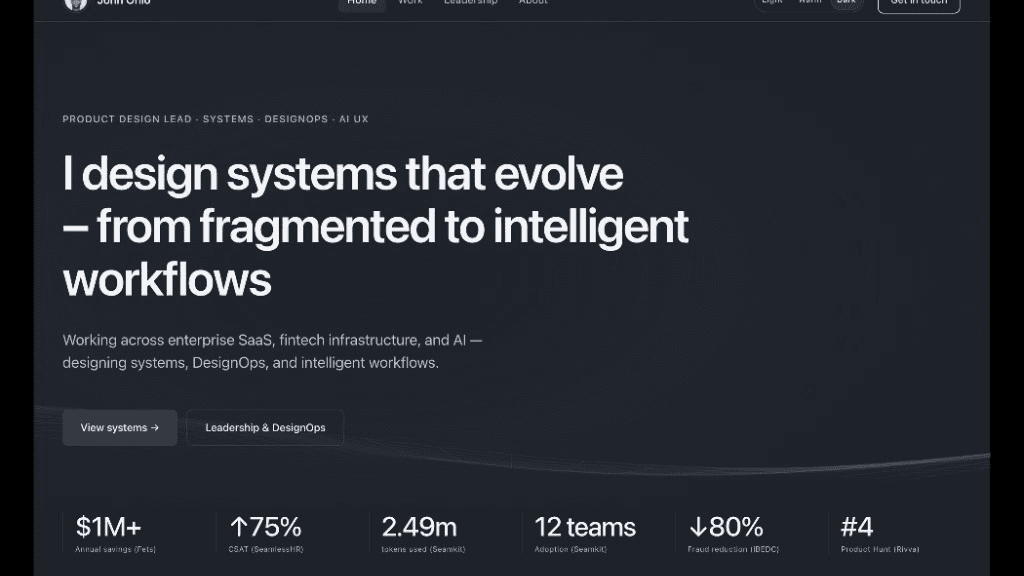
An orchestration system for AI-assisted design execution. Instead of using AI as a tool, this project treats it as a system — with defined roles, shared state, and governed decision boundaries.
Role
System designer, orchestrator, and decision-maker throughout. Every judgment call — what to build, in what order, and which tool to trust — was mine.
Scope
Workflow design, input synthesis, Figma integration, decision logging, multi-tool coordination, and live deployment.
Context
A partially abandoned Figma prototype, a CV, case study documents, presentation decks, and years of work across enterprise SaaS, fintech, and DesignOps had never been pulled into a single deployable portfolio. No production codebase experience. The missing piece was not a developer — it was orchestration.
Problem
Years of work scattered across a dozen files with no single through-line. No engineering background. And mid-build, the tools themselves started working against the project — burning through compute limits, losing context between sessions, repeating decisions that were already made.
Approach
The first decision was to share everything upfront — prototype, CV, case study docs, presentations — before asking any tool to produce anything. When compute limits surfaced mid-build, the response wasn't to lower the ambition. It was to redesign who did what: one tool for strategy and judgment calls, another for volume output, a third for independent review — Codex flagged a real asset encoding error on a merged PR without being asked — a fourth for voice. A shared repository became the project's memory — the one place where decisions survived past any single session. Deployments went live continuously, not at the end. Late in the build, the design file and the codebase started feeding each other: changes in one reflected in the other. The loop closed — design and code stopped waiting on each other.
Outcomes
The site shipped across four sections with a full decision log and a live design-to-code feedback loop. The more transferable result was a shift in how execution worked — something to direct rather than absorb. The judgment that mattered most throughout: knowing which decisions needed a human and which could be handed off to a well-structured system. That's the same instinct behind every DesignOps problem.
System Evolution
Mid-build, compute limits surfaced before the work was done. Pushing through with the same setup would have meant lower quality or lower ambition. Instead, I treated it as a system design problem — redistributed responsibility across tools, reserved the most capable one for decisions that actually needed it. The constraint produced better role clarity than a clean start would have. The constraint was the architecture.
System Impact
The deeper problem wasn't compute — it was memory. Each tool session started fresh. Decisions made in one session had no way of reaching the next. The fix was to document every significant decision in the repository itself, with the reasoning attached. Any tool, in any session, could read the history and continue without repeating what had already been resolved. Writing decisions down as they were made is what held the system together. ADR-008 formalised the gate: major pushes must update the decision log so rationale never lives only in a chat session. It blocked a PR mid-build when the rule wasn't followed — no human needed to catch it.
Key Insight
Keeping the design file in sync with the codebase changed what design feedback felt like. Changes didn't have to wait for a developer to interpret them — they moved directly into the build. The gap between design and engineering didn't close — but it became something you could cross in either direction. That changes what design is allowed to do.
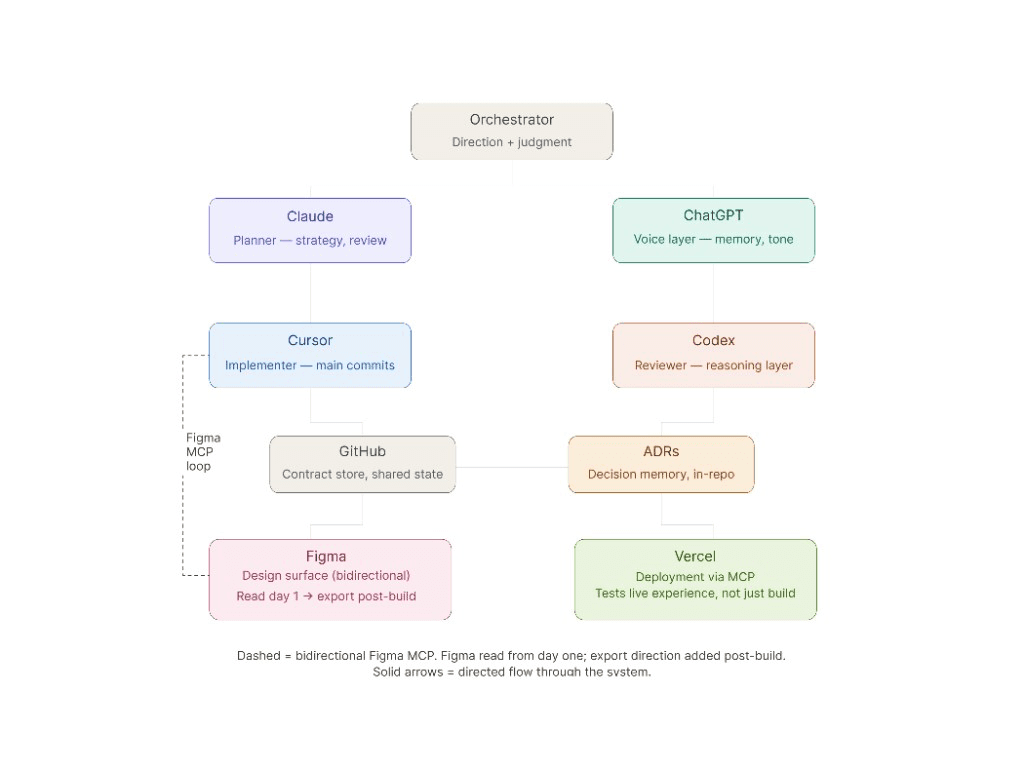
Orchestrator, tools, shared state, ADRs, deploy — and the Figma MCP loop.
System proof
Independent review and governance ran continuously. Codex reviewed PRs without being asked, and ADR-008 blocked merges when major changes landed without an ADR update — no human needed to enforce it.
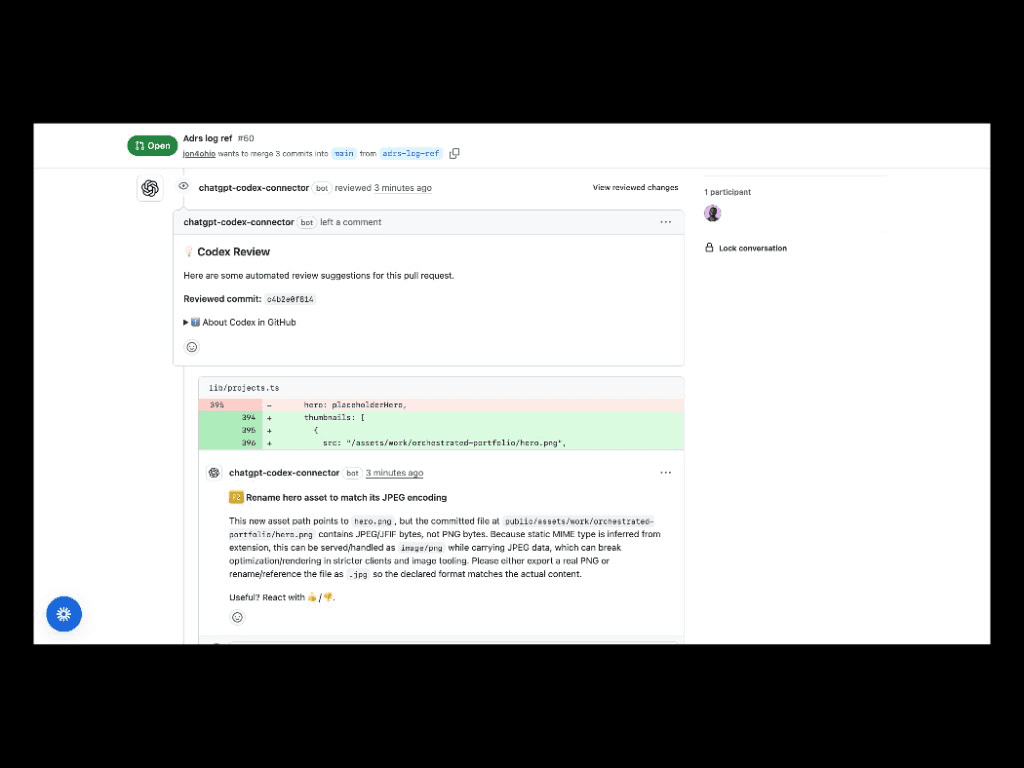
Codex: JPEG bytes committed as hero.png.
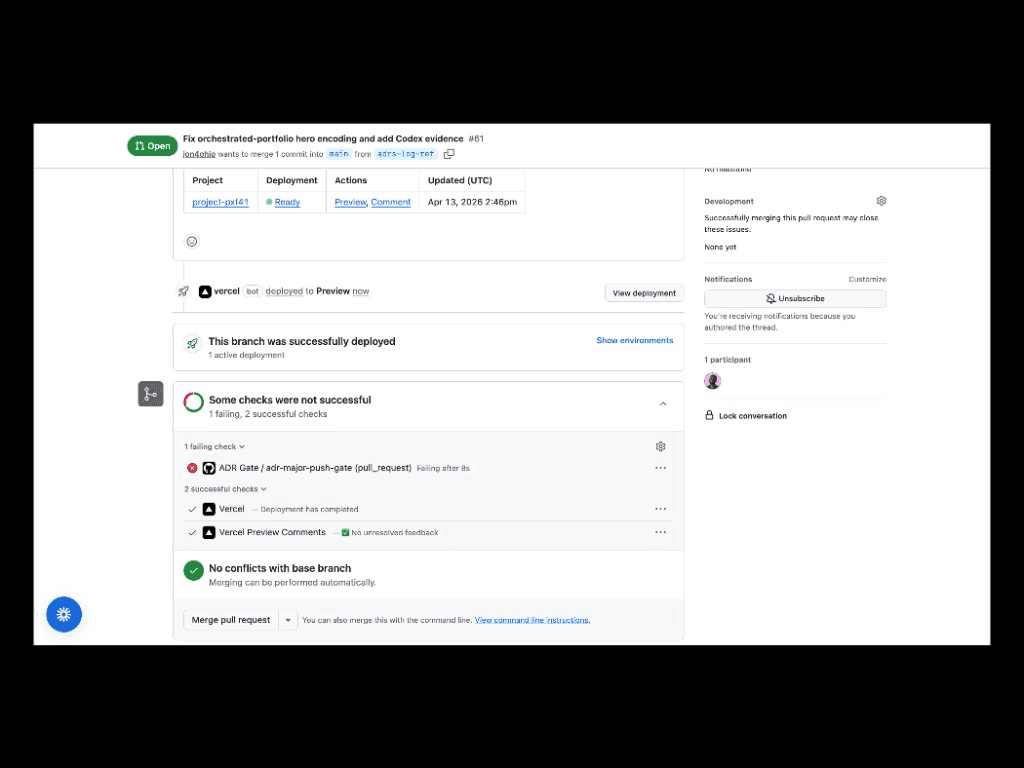
ADR gate: major change without an ADR update.
Design loop
The Figma file stayed current with the codebase throughout the build — pages for each case study, synced with what shipped.
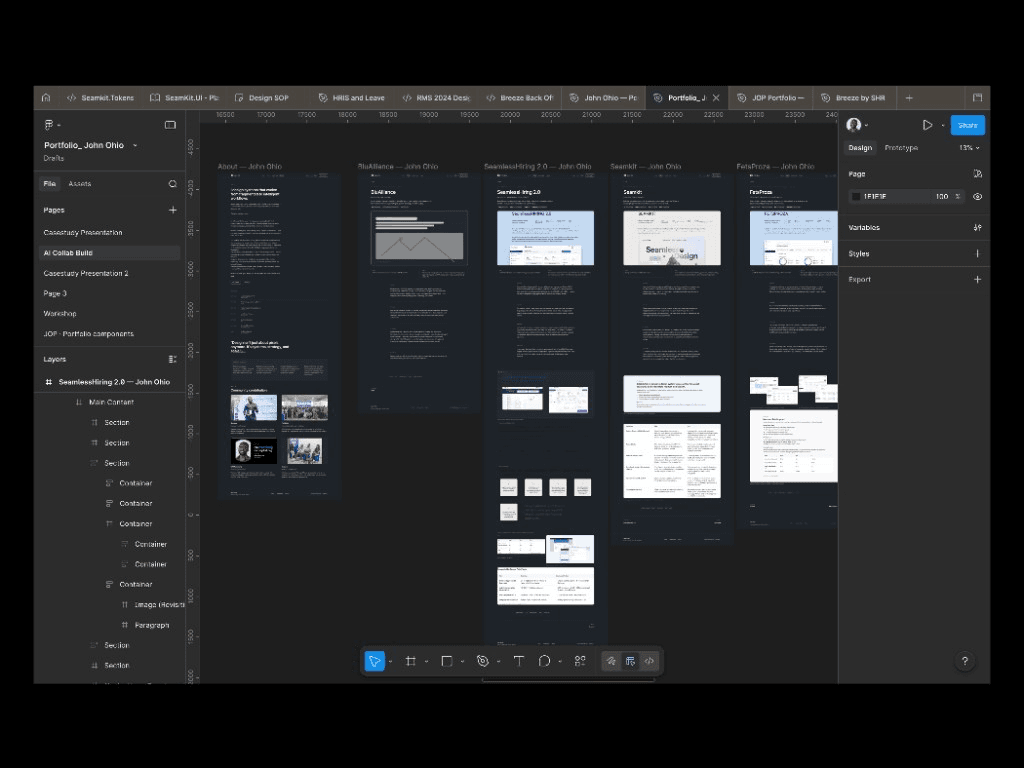
Figma case study pages kept in sync with what shipped.
Implementation surface
Cursor handled implementation volume — edits, builds, and ADR logging — while the agent panel ran merge checks and conflict resolution in the same session.
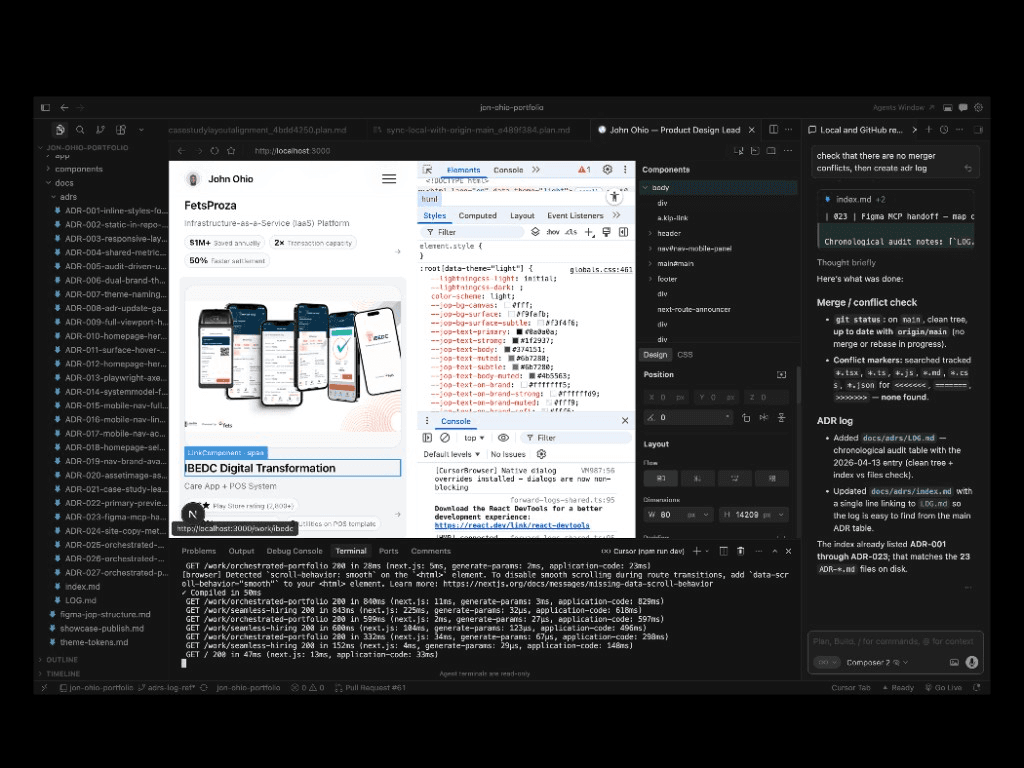
Cursor: dev server, ADR log, and merge checks in one session.
Related work
- SeamkitEnterprise Design System Architecture
- SeamlessHiring 2.0Recruitment Management System (RMS)
- FetsProzaEnterprise operating platform for FETS
Cross-linked via the portfolio knowledge graph — same IA, richer discovery (V2.1).